IDLE
PN-III-P4-ID-PCE-2020-1187

For the wide audience

Comments, opinions and criticism on the project "Idle Crayfish: from the unknown to the next generation of species conservation assessment" — points of view expressed by our research team, and from the outside.

Mission done! BTS Report 2023 Report 2022 Report 2021 Press release Emotions & high stakes Competition info
Update · April 2025
Mission accomplished!
Mission accomplished

The Idle Crayfish (Austropotamobius bihariensis), a species endemic to Romania's Apuseni Mountains and scientifically described in 2019, has reached two major milestones in its conservation journey: it has been officially included in the IUCN Red List of Threatened Species and granted legal protection through its inclusion in Annex 3 and Annex 5A of GEO 7/2025, the recent update of Romania's national legislation transposing the EU Habitats Directive (GEO 57/2007).

These achievements crown the efforts carried out within the framework of this project, offering the species a clear pathway for monitoring, reporting, and concrete conservation measures at both national and international levels. A significant step forward for local biodiversity and a successful example of aligning scientific research with environmental policy.

April 1, 2025
Personal account · December 2023
Behind the scenes
Dr. Lucian Pârvulescu

If the results of a project stand on the shoulders of a team, I dedicate this space to the people who make it up.

PhD student Mihaela C. Ion, member of the research team, successfully defended her PhD thesis entitled "Ecology and ethology in some macroarthropod species (Crustacea and Chilopoda)", coordinated by Acad. CSI Dr. Dumitru Murariu.

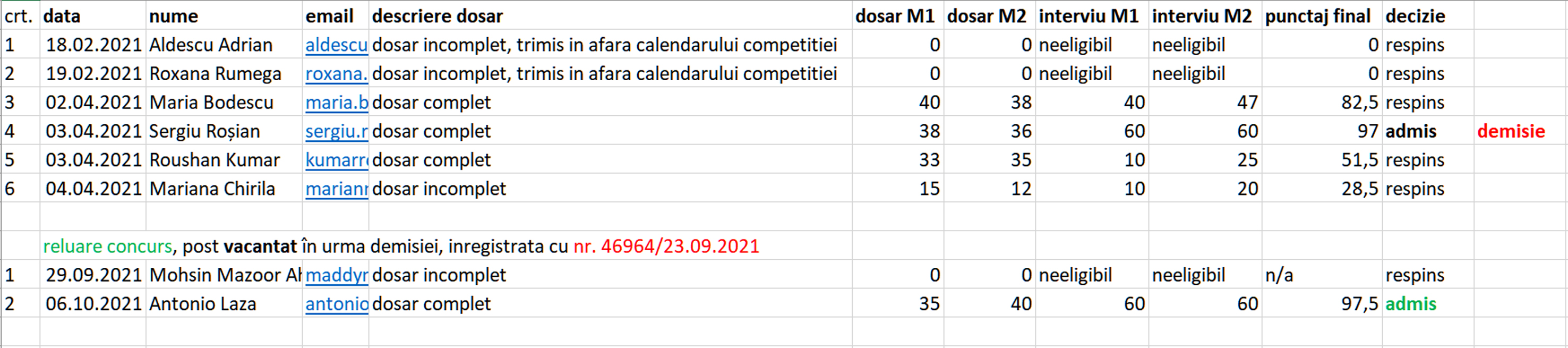
Antonio V. Laza, a student hired by competition into the project team, actively participated in field work, in the writing of scientific papers, and in international conferences. He is currently a graduate in Biology and a master's student at our university, focusing on crayfish metabolism research.

David Livadariu and Andreea M. Lamoly, volunteer students in the project, have started their own path on crayfish phylogeny and are already actively participating in scientific papers (proven by co-authorship) and prestigious conferences.

An important professional achievement of my career was to defend the habilitation thesis entitled "Spatial ecology through the eyes of crayfish species" and to obtain the habilitation by Ministerial Order 3299 of 22.02.2022. Thus, today I hold a permanent position of Professor at the West University of Timisoara. As a result, we have established for the first time PhD-level studies in Biology at West University of Timisoara, attached to the Doctoral School of Exact Sciences and Natural Sciences (IOSUD–UVT). Our research activities revolve around the Crayfish Research Center (EERTIS portal). I am coordinating the first PhD student, Andrei-Robert Ács, whose thesis project is perfectly adapted to the subject of this project — he worked as a volunteer during the entire implementation.

Equally important, this project was an excellent opportunity to strengthen the long-term collaboration with a prestigious team coordinated by Kathrin Theissinger (LOEWE-TBG, Senckenberg Nature Research Institute, Frankfurt), a real preamble to the submission of a partnership project in European funding programmes.

Last but not least, the return on our public money can be found here. The statistics include only papers published or accepted for publication; by consulting the Results page, the latest statistics can be accessed.

After final reporting, our project was evaluated and rated "excellent".

December 18, 2023
Annual Report · November 2023
Annual Report: 2023
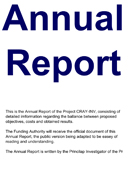
Annual Report
This Annual Report contains detailed information regarding the balance between proposed objectives, costs and obtained results. The Funding Agency (UEFISCDI) will receive the official document; this public version is adapted for easy reading. Written and assumed by the Principal Investigator.

Regarding the approach to publish preliminary data, a paper that last year was sent for evaluation was this year accepted and can be assimilated to the 1st working package — Assessment of ecological requirements.

PLoS ONE paper
PLoS ONE
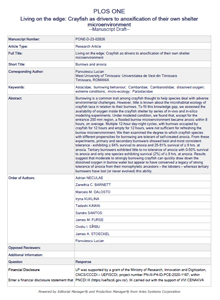
Living on the edge: Crayfish as drivers to anoxification of their own shelter microenvironment
Neculae A et al. + Pârvulescu L · 2024 · Vol. 19: e0287888
↗ View paper

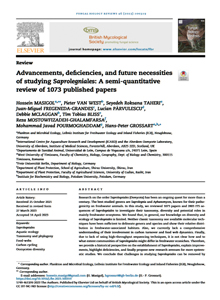
Another paper — a review — became timely following the invitation of a postdoctoral fellow as a result of his expertise on the issue of Aphanomyces pathogens in crayfish.

Fungal Biology Reviews paper
Fungal Biology Reviews
Review on Aphanomyces astaci and crayfish plague
Masigol H et al. + Pârvulescu L · 2023 · Vol. 46: 100319
↗ View paper

With the onset of the favourable field investigation season, we shifted the effort towards collecting new data. Since we were pleasantly surprised to identify populations of the Idle Crayfish outside the expected (previously known) range, we extended the field work as far as possible to thoroughly investigate these basins as well. This resulted in a delay in the timing of most planned work reaching the maturity threshold required for publication. Even so, at the time of final reporting, most of the work undertaken is at an advanced stage.

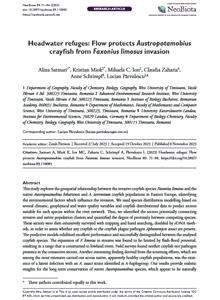
Using modern methods of spatial analysis and mathematical modelling, we tested and validated the hypothesis explaining the lack of expansion of the invasive crayfish Faxonius limosus towards and within areas occupied by native crayfish of the genus Austropotamobius. Water velocity, estimated using a specially constructed index based on digital data, appears to be the most important element keeping invasive crayfish at bay. The paper also contains the largest screening on the incidence of the pathogen Aphanomyces astaci in native populations, analysed by classical and eDNA methods. This work, from the 1st working package, is published in a prestigious Q1 (red zone) journal.

NeoBiota paper
NeoBiota · Q1 WoS
Range expansion of invasive Faxonius limosus halted at the boundary of native Austropotamobius crayfish
Satmari A, Miok K, Ion MC, Zaharia C, Schrimpf A, Pârvulescu L · 2023 · NeoBiota 89: 71–94
↗ View paper

The 2nd working package — Assessment of genetic diversity starts with two manuscripts. One is based on biological material collected during 2021 and supplemented with samples from summer 2022; the project team conducted state-of-the-art population genomics analyses using the ddRAD repetitive SNP sequence analysis technique.

BMC Ecology and Evolution paper
BMC Ecology and Evolution
Population genomics of the endemic Austropotamobius bihariensis via ddRAD sequencing
Bonassin L, Pârvulescu L et al. · 2024 · BMC Ecology and Evolution 24: 78
↗ View paper

The second paper uses the solid landmarks provided by the biogeography and evolution of the crayfish in the region. It is the first time that a study has compiled and analysed existing molecular data in the literature and constructed a phylogeny of the entire genus Austropotamobius based on mitochondrial cytochrome oxidase subunit I, providing a broad and surprisingly clear picture of the main biogeographical events at the European level. We invite readers to check the Results page for the latest publication status.

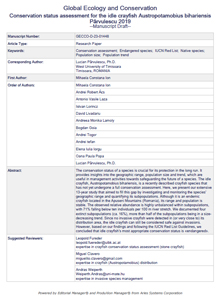
With the accumulation of data, the project team tackled Objective 2 — establishing the conservation measures for Idle Crayfish populations. Two papers address this. The first delivers the most appropriate conservation status for the Idle Crayfish based on IUCN Red List methodology, concluding that "Endangered" is the most appropriate status.

Global Ecology and Conservation paper
Global Ecology and Conservation
Conservation status assessment of the endemic Austropotamobius bihariensis
Ion MC, Ács AR, Laza AV et al. + Pârvulescu L · 2024 · Vol. 50: e02847
↗ View paper

The second paper, designed for practical use by environmental managers, provides data on optimal habitat quality and subpopulation size in three different scenarios (optimistic, conservative, pessimistic), separately for each protected area in the region (Natura 2000 site or nature park).

Our efforts to provide a future for the Idle Crayfish do not stop at science alone. All the legal and necessary steps have been taken to include Austropotamobius bihariensis in the annexes updating the Romanian Government Emergency Ordinance No 57/2007 on the regime of protected natural areas, conservation of natural habitats, wild flora and fauna. The application was in Parliament and followed the specific course until publication in the Official Gazette of Romania.

In order to promote and disseminate the results of the project, we participated in numerous scientific communications, during which the young researchers in the team, as well as the student volunteers, were promoted to gain experience. The full list of conference participations and access to the content presented can be consulted on the Results page.

November 27, 2023
Annual Report · November 2022
Annual Report: 2022
Annual Report
This Annual Report contains detailed information regarding the balance between proposed objectives, costs and obtained results. The Funding Agency (UEFISCDI) will receive the official document; this public version is adapted for easy reading. Written and assumed by the Principal Investigator.

In the inertia of the preliminary data, we continued to work on the dataset assimilated to the 1st working package — Assessment of ecological requirements. We started from the idea that, in their ecology, crayfish shelter is often poorly penetrable for oxygen from the air. We thus experimented — both through live animal approaches and computer simulations — the behaviour of dissolved oxygen available within such a microhabitat. To our surprise, a shelter longer than 20 cm occupied with an adult-sized crayfish becomes anoxic in about 8 hours, because diffusion into the water cannot satisfy the consumption rate of the live crayfish. The major surprise was to find that the crayfish survives even after the anoxic threshold is reached, with duration ranging from 3 to 12 hours. We went further and converged a team of researchers from several countries (Australia, Japan, Brazil, USA) to see if other crayfish can also survive without oxygen. The work "Living on the edge: Crayfish as drivers to anoxification of their own shelter microenvironment" was under review at PLoS ONE.

The process of collecting new data related to the 1st working package continued. Since at the time of project submission the distribution of the Idle Crayfish (A. bihariensis) was known to cover only the western part of the Apuseni Mountains (the upper reaches of the Criș), the project team worked intensively to find out if populations also exist in the eastern part — the Arieș and Someș rivers. Three populations have already been identified in the upper Arieș basin. For all investigated populations we collected material for analyses specific to work package II: tissue samples for population genetics, and exoskeleton parts (uropods) to investigate the presence or absence of the pathogen Aphanomyces astaci. All necessary permits were requested and obtained during 2022 under the Nagoya Protocol (collection permits from the Environmental Protection Agencies of 5 counties: Bihor, Arad, Alba, Sălaj, Cluj; permit from the National Agency for Protected Natural Areas; opinion of the Romanian Academy).

For the 2nd working package — Assessment of genetic diversity, using the biological material collected during 2021 and completed with samples from summer 2022, the project team prepared the ddRAD genotyping sample batch. We expect that by acquiring these results we will gain a better understanding of the origin of this newly described species. The reference genome sequenced in 2022 is of real help in this process.

In order to promote and disseminate the results of the project, the PI was invited to the International Scientific Communications Session of the "Țării Crișurilor" Museum Complex, Oradea, presenting "Hidden in plain sight: A journey on plate tectonics of the Apuseni Mountains revealed a new European crayfish species." Volunteer student David Livadariu also participated. The year 2022 was also the year of IAA23 — Symposium of the International Association of Astacology (University of South Bohemia, Hluboká nad Vltavou, Czech Republic). Papers presented by the project team: "Towards real-time global mapping of crayfish species and crayfish plague occurrence"; "Strength and boldness: a comparison of native Pontastacus leptodactylus and invasive Faxonius limosus"; "Mapping the scientific research on crayfish behaviour: A bibliometric analysis." The participation team included PI, Research Assistant, PhD student Mihaela C. Ion, and Laboratory Assistant Antonio V. Laza.

IAA23 — Hluboká nad Vltavou, June 2022
"Țării Crișurilor" Museum Complex — Oradea, October 2022
November 28, 2022
Annual Report · December 2021
Annual Report: 2021
Annual Report
This Annual Report contains detailed information regarding the balance between proposed objectives, costs and obtained results. The Funding Agency (UEFISCDI) will receive the official document; this public version is adapted for easy reading. Written and assumed by the Principal Investigator.

At the moment of submitting the application, we already had an important set of preliminary data on the basis of which the funding application's main hypotheses were built. Using these data, we carried out two scientific papers subscribing to the 1st working package — Assessment of ecological requirements.

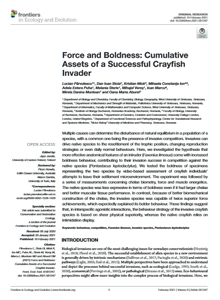
The first paper highlights certain morphological and behavioural assets of the invasive species Faxonius limosus; the major conclusion is that this species has a real biological advantage highlighted by a higher level of boldness due to claws whose configuration can provide a contraction force far superior to that of the native species Pontastacus leptodactylus.

Frontiers paper
Frontiers in Ecology and Evolution
Boldness and claw strength of invasive vs. native crayfish: a comparative study
Pârvulescu L, Stoia DI, Miok K, Ion MC et al. · 2021 · Vol. 9: 581247
↗ View paper

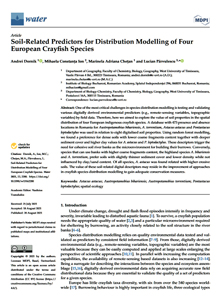
In the second paper we analysed a consistent set of data on the distribution of native crayfish species in Romania in the context of soil type spatiality. This analysis highlighted the specificity of Austropotamobius bihariensis for the compact type of substrate, which confirms the need for stable river banks in which individuals of this species dig galleries.

Water paper
Water
Substrate preferences of native crayfish in Romania: a spatial analysis
Dornik A, Ion MC, Chețan MA, Pârvulescu L · 2021 · Vol. 13: 2280
↗ View paper

The team worked hard during the summer to complete the distribution maps of the Idle Crayfish (A. bihariensis) in the Apuseni Mountains, activities related to the 1st working package. This process was divided into two stages (2021 and 2022), the first stage focusing on the watercourses in the west — the Criș basins. Already known populations were reconfirmed and 7 new populations were identified.

The most important challenge of this stage is the sequencing of a reference genome — an activity related to the 2nd working package — Assessment of genetic diversity. The Idle Crayfish (A. bihariensis) and implicitly our project are pioneering this objective in Romania and also in Europe.

From the perspective of scientific communications, the PI lectured "Hidden in plain sight" at the Evolutionary Zoology and Human Biology Department, University of Debrecen, Hungary (April 15, 2021). Part of the project's preliminary results were presented (in Romanian) by Mihaela C. Ion at the "61st Annual Session of Scientific Communication," Institute of Biology, Bucharest (December 10, 2021).

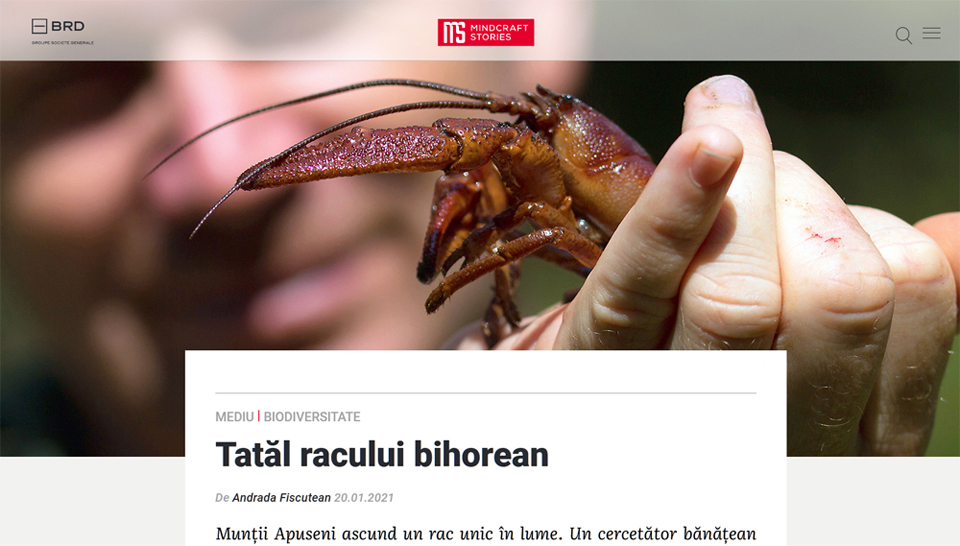
There were also press releases related to the project scope. The species story was reported in the Mindcraft Stories article "A crayfish father" (in Romanian), in Bihoreanul and Jurnalul Satului Căbești. Radio Romania News dedicated two episodes in the show "Vatra Luminoasă," and during the series "Deschis la Știință" with Cristian Presură, the Idle Crayfish was the headline (here).

University of Debrecen — April 15, 2021
Institute of Biology Bucharest — December 10, 2021

This project was also the necessary requirement to meet the minimum criteria for the Habilitation for the PI. The habilitation thesis entitled "Spatial ecology through the prism of crayfish species" (accessible in full format here) was written, with the public defence taking place on June 16, 2021, within the Doctoral School of Integrative Biology at Babeș-Bolyai University Cluj-Napoca.

A crucial point of internationalization is the affiliation of the PI to the European Reference Genome Atlas (ERGA) initiative as a regional representative. ERGA aims to create a database with reference-quality genomes for all European species. Promoting students is a priority; around the project we co-opted and integrated two volunteer students involved in various field actions.

December 1, 2021
Press release · January 2021
Press release
January 20, 2021
Project launch · January 2021
Emotions & high stakes
Dr. Lucian Pârvulescu

More than ever, this competition has meant everything to my professional career. Not one but two are the reasons why this project meant so much.

The first, and most obvious, is my desire to offer a future to my new-born "child" — the Idle Crayfish (Austropotamobius bihariensis). I would like to see it protected from the environmental threats. It needs special care because the populations are small, restricted to a small geographical area (true, mostly in protected areas), which involves a number of problems: risk of biological degradation due to inbreeding, risk of being exposed, and consequently literally exterminated by invasive species and the pathogens they carry.

The second reason is that I really want to coagulate a team around me. This can be done when you have the right to coordinate doctorates. I kept trying to keep young students around me but their interest was probably not very clearly established, and I lost them along the way. Moreover, those interested in research had to choose another coordinator during their academic career. All I needed to initiate the habilitation procedure was to have in my portfolio, in addition to a certain score I had already satisfied for more than 7 years, two projects as Principal Investigator — and I only had one won in 2015.

So here are the ingredients for which this project competition meant a chance for me. Unfortunately, such project competitions have not had regularly open calls, which is frustrating because you don't have a horizon in which to reorganize yourself.

I gave all my best this summer. I wrote, organized and applied with a project proposal that seems to have impressed the evaluators enough to give it 93.4 points — placing me 13th out of a total of 81 submitted projects, on a fundable position. Some criticism from the reviewers worth mentioning: (i) they found my CV good, but not great — frustratingly, after I submitted the application, some of my most important papers received acceptance in significant journals; (ii) I didn't have any prizes — and rightly, I didn't. Again, after sending the proposal, I received two extremely important awards: the "Mircea Zăgănescu" Award from West University of Timisoara and the "Award for Excellence in Research" from Ad Astra Association; and (iii) the fact that I was not the editor of any major scientific journal — and after submission, I was invited to be editor of Water and more recently at the Frontiers publishing group.

Ok, I won. Now at work!

January 4, 2021

Technical information about the competition

Program PN III — Fundamental and frontier research
Subprogram Exploratory Research Projects
Financing Romanian Government
Financing Authority Romanian National Authority for Scientific Research and Innovation (UEFISCDI)
Applicant's Guide here »
Accepted proposals 2021, domain Biology and Ecology here »